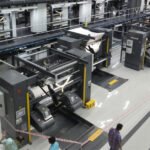
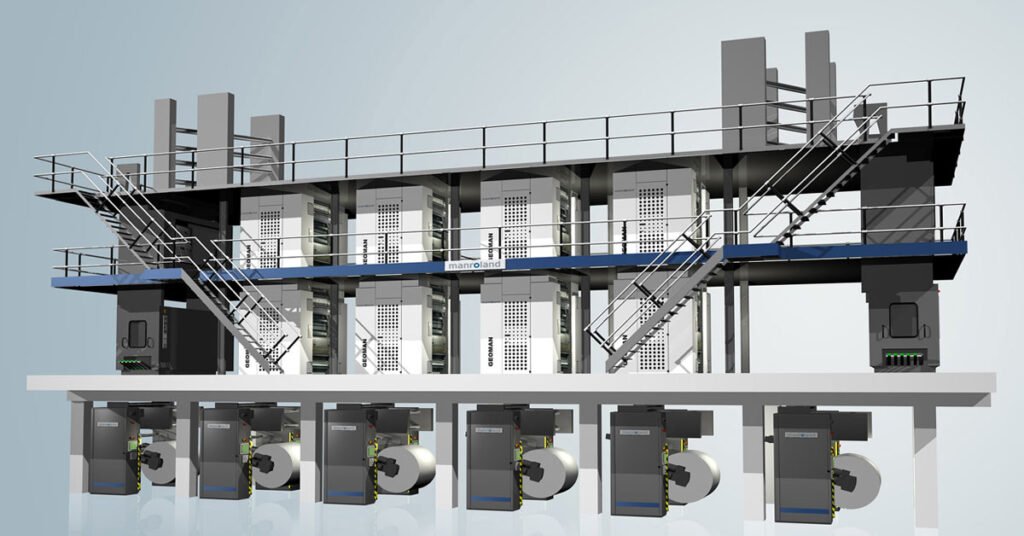
A newspaper printing press is one of the most important decisions a publisher makes. Selecting the right newspaper printing machine influences production costs, scalability, and long-term operational performance. Consider two regional dailies with similar circulation and page counts. One chooses a press class aligned to future growth and edition complexity. The other buys only for today’s print order. A few years later, one scales efficiently while the other faces capacity constraints and rising operating costs. The difference often starts with the press class decision.
Despite continued investment in print operations worldwide, many press-buying discussions still begin with budget and headline output. Far fewer focus on circulation trends, automation requirements, and long-term production flexibility.
As the Indian subsidiary of one of the world’s established newspaper press manufacturers, manroland Goss Web Systems GmbH, Augsburg, manroland Goss India brings decades of newspaper press engineering expertise to the Indian market. Its India-based service team supports publishers across installation, modernization, and lifecycle service.
This guide explains how publishers and commercial printers should evaluate newspaper press class against circulation, automation, and run profile. It also highlights key considerations when selecting a newspaper printing press in India for future growth and operational efficiency.
How Newspaper Printing Press Classes Are Defined
Not all newspaper presses are built for the same production environment. Press class is defined by architecture, output capability, and the operating model it is designed to support.
A newspaper printing press class refers to the production category a press is designed for, based on factors such as web width, page capacity, throughput, automation level, and the circulation volumes it is intended to support.
Most newspaper production environments operate on web offset press technology, where press architecture, web width, and automation depth determine production capability and operating economics.
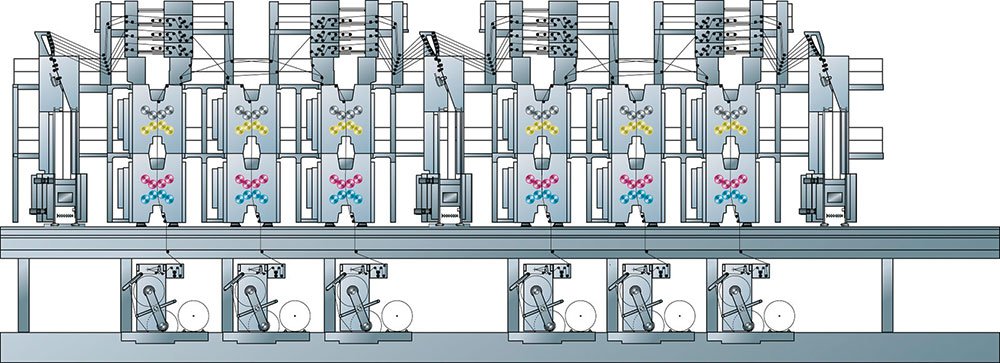
Single Width vs Double Width — The Core Architecture Split
The first distinction is between single-width and double-width press architectures. A single-width press uses a narrower web and is typically configured for regional newspapers, contract printing, and medium-volume production. A double-width press handles a wider web, delivers more pages per revolution, and is designed for higher circulation environments.
The choice affects more than output. Single-width systems generally require less floor space and lower initial investment. Double-width systems provide greater throughput and become more economical as run lengths, edition volumes, and circulation demands increase.
Why Class Decides Cost-Per-Copy, Not Just Output
Many publishers compare presses by maximum copies per hour. In practice, profitability depends on cost-per-copy. Press class influences throughput, staffing requirements, plate change frequency, waste levels, and production flexibility.
A press that exceeds production requirements can create unnecessary operating costs. A press that is undersized may struggle to meet deadlines or support future growth. The most effective choice is the one that aligns output capacity with the realities of the production schedule.
Understanding press class as an operational decision rather than a speed decision creates the foundation for better circulation planning, investment discipline, and long-term production efficiency.
How to Match Newspaper Press Class to Circulation Volume
The right newspaper press class should match not only current circulation but also future growth, edition complexity, and production flexibility.
Reading the Circulation Curve, Not Just Today’s Print Order
Many newspaper publishers size a press around today’s print order. The better approach is to evaluate the circulation curve over the next five years. A press is a long-term infrastructure investment, and the wrong sizing decision often creates operational constraints long before the equipment reaches the end of its service life.
- Five-Year Growth Outlook — Compare projected circulation volumes against current production levels before finalizing press capacity.
- Edition Complexity — Factor in regional editions, pull-outs, zonal variations, and special publishing requirements.
- Production Headroom — Build sufficient capacity to accommodate circulation growth without major reinvestment.
- Future Operating Requirements — Consider likely changes in pagination, production schedules, deadlines, and edition strategy
Where Single-Width Newspaper Presses Fit
Single-width newspaper presses are commonly deployed in regional newspaper operations and medium-volume production environments. Their economics often align well with publishers seeking flexibility, manageable operating costs, and efficient utilization across varied print schedules.
Regional Circulation Fit — Well suited to regional circulation bands and mid-tier newspaper operations.
Manning Economics — Lower staffing requirements help support efficient shift utilization and operating costs.
Run-Length Efficiency — Plate change frequency and production rhythm align well with short and medium-length production runs.
manroland Goss India Platforms — Within the manroland Goss India portfolio, UNISET supports regional and mid-volume newspaper production. CROMOMAN serves higher circulation operations and provides additional flexibility for multiple editions and evolving production requirements.
Matching press class to circulation volume is less about maximum output and more about selecting capacity that supports sustainable growth efficiently.
What to Evaluate Before Choosing a Newspaper Press Class
Selecting the right newspaper press class requires more than comparing specifications. Several operational variables should be evaluated before requesting quotations.
The Five Variables That Determine Newspaper Press Class Fit
Press selection should begin with production requirements, not equipment specifications. Before comparing models or budgets, publishers should evaluate the operational factors that determine whether a press will remain effective throughout its service life.
The five variables that deserve a place on every evaluation sheet are:
- Circulation projection horizon — expected print volumes over the next three to five years.
- Edition complexity — regional editions, zonal splits, inserts, and special publishing requirements.
- Automation depth — the level of automation needed to support production efficiency and staffing goals.
- Plant footprint and power availability — physical and infrastructure constraints within the production facility.
- Service continuity — access to technical support, spare parts, upgrades, and long-term lifecycle assistance.
Is the Press Sized to the Five-Year Circulation Curve or Last Year’s Print Order?
Many newspaper plants size a press around current demand and discover capacity limitations within a few years. A better approach is to evaluate the five-year circulation outlook, factoring in edition growth, regional pull-outs, and changing production requirements. Capacity headroom should be built into the press-class decision itself rather than addressed later through additional capital expenditure.
The strongest press-class decisions balance current production needs with future operating realities, creating flexibility without introducing unnecessary capital or operating costs.
Why Automation Depth Matters in a Newspaper Printing Press
Press architecture determines capacity, but automation often determines profitability. It influences waste, staffing requirements, consistency, and production flexibility.
- Makeready time and first-good-copy speed — Features such as Inline Process Control and automatic plate loading reduce makeready time, shorten production changeovers, and lower start-up waste before the first saleable copy is produced.
- Closed-loop register and colour control — Automated register and colour management improve production consistency, reduce waste, and lower operator intervention throughout the print run.
- Operator load and manning cost — Automation depth directly affects how many operators are required on each shift. Higher automation can improve efficiency while reducing production complexity.
- Multi-edition handling — High-circulation newspapers often run multiple regional editions and time-sensitive production schedules. Double-width newspaper press architectures are better suited to these demanding workflows.
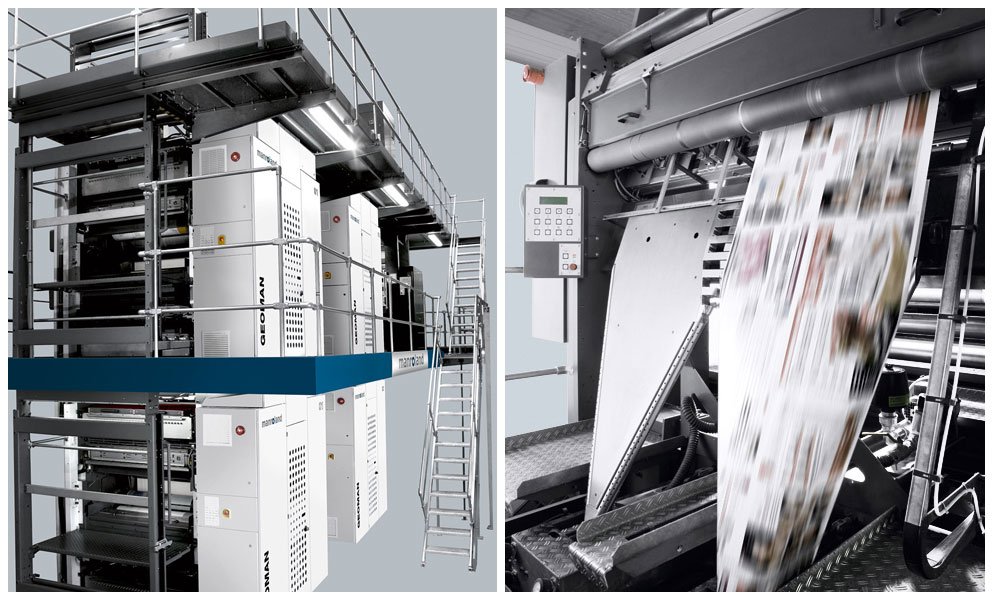
- Where the investment pays back — The return is rarely measured by speed alone. As automation aligns with run complexity, publishers benefit from lower waste, improved consistency, and better cost-per-copy economics. Platforms such as GEOMAN e:line and COLORMAN e:line integrate automation options designed to support these production requirements.
Automation should be evaluated as an operational investment rather than an equipment feature, because its value is realized across every production run.
FAQs: Newspaper Printing Press
Which newspaper press class is best for a regional newspaper?
There is no single best newspaper press class for every regional publisher. The right choice depends on circulation volume, edition complexity, growth projections, available plant space, and automation requirements. Many regional newspapers operate efficiently on single-width newspaper press platforms because they balance production capacity with operating economics and future scalability.
How do publishers choose between a single-width and double-width newspaper press?
Publishers should evaluate circulation forecasts, edition strategy, run lengths, automation requirements, staffing models, and long-term growth plans. Single-width presses are often suited to regional and mid-volume production, while double-width newspaper presses are designed for higher-volume operations, multiple editions, and greater throughput requirements.
Conclusion
Press class is the decision beneath every other newspaper press investment. It influences cost-per-copy, staffing requirements, production flexibility, and the output a plant can sustain over the next five years.
Single-width and double-width newspaper printing presses should not be viewed as a price ladder. They are a fit ladder. The right choice depends on circulation volume, edition complexity, automation requirements, and long-term production objectives.
When selected correctly, a newspaper press class aligns infrastructure investment with circulation requirements, automation needs, and operational goals. It supports capital-efficiency, operational continuity, future growth, and long-term return on investment throughout the press lifecycle.
Talk to the manroland Goss India team for a newspaper press class assessment aligned to your circulation volume, edition strategy, and production requirements. ENQUIRE NOW.
Our Digital Presence:
Explore manroland Goss India across web offset press solutions, certified pre-owned systems, print service support, consumables, and industry insights built for newspaper, commercial, and packaging print operations. From press installations and modernization to lifecycle support and productivity improvement, our platforms showcase how Indian print plants are adapting to changing production and capex realities.
Visit our website to explore products, services, and insights from the print industry.
Connect with us on:
Website | Products | Services | Insights
Stay updated through:
Instagram | YouTube