A digital press completes one book job and the next arrives with a different format, substrate, and run length. Industrial digital book finishing now has to absorb that variation without slowing production or compromising output quality.
India’s book publishing market is valued at approximately USD 10.3–10.4 billion (~₹85,000 crore). As the market expands, more titles, shorter runs, and changing formats are placing greater demands on digital book finishing workflows and production efficiency.
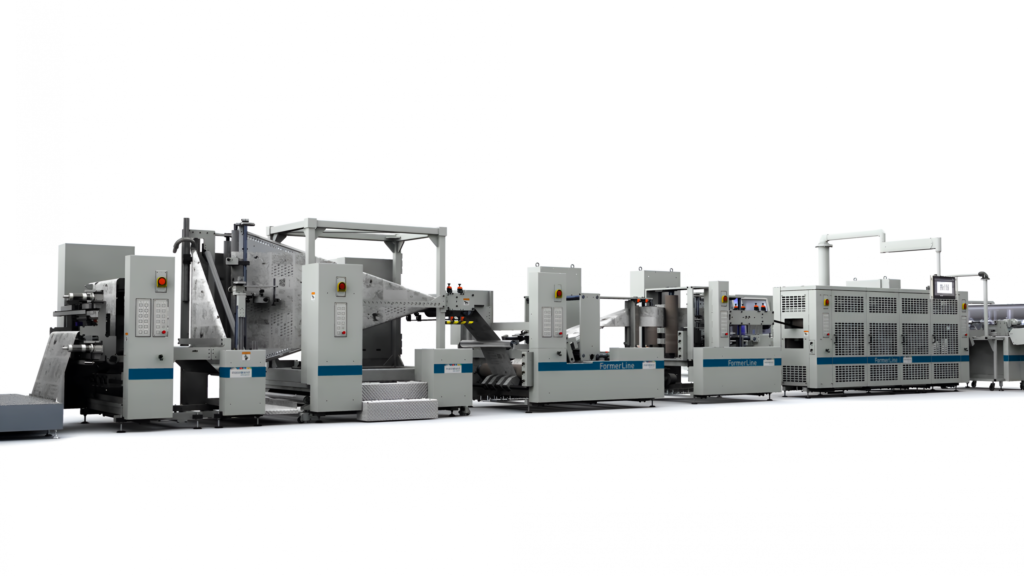
manroland Goss brings decades of web printing and finishing engineering experience to this changing production environment. FormerLine has been developed for industrial digital book finishing across changing run lengths, formats, substrates, and production requirements.
This article examines how industrial digital book finishing is engineered to do more than increase production speed. It must maintain fold quality, workflow efficiency, and book-block stability as production requirements continue to evolve.
Production Variation Starts at the Web
Variation does not wait for the finishing stage. An industrial digital print finishing system must absorb production changes the moment the web reaches the line, and its architecture has to respond without disrupting production flow.
Smart Drive Technology maintains stable web tension, synchronises continuously with the digital press, and compensates for drive irregularities, helping preserve consistent production flow as jobs change.
Inline and Nearline Configuration
FormerLine supports both inline integration with digital presses and nearline configuration for greater production flexibility. Inline configuration connects finishing directly with digital print production, creating a continuous production flow. Nearline configuration allows finishing to operate as a separate production stage. Both configurations enable printers to align finishing with their production strategy, workflow requirements, and plant setup, while supporting books, magazines, catalogues, and mailings across industrial digital print environments.

Web Width, Page Range and Application
The line is built to take different work rather than one repeating job. Web widths reach up to 1,500 mm, a copy can carry up to 24 pages in the largest configuration, and cut-off lengths run from 150 to 496 mm, supporting a wide range of product formats. The application range covers book signatures, auxiliary-glued book blocks, flyers, mailings, and several folded products, so one line can move between book work and commercial work as the order book demands, without a second setup to bridge the two.
Accepting variation at the web is the first requirement. Holding quality once that variation is inside the line is the harder problem.
Folding and Cutting Hold Quality Through Change
FormerLine combines proven folding technology with precise cutting for consistent output. Its folding architecture supports different paper types, while the cutting module is designed for high-precision cutting and gentle processing of lightweight materials.
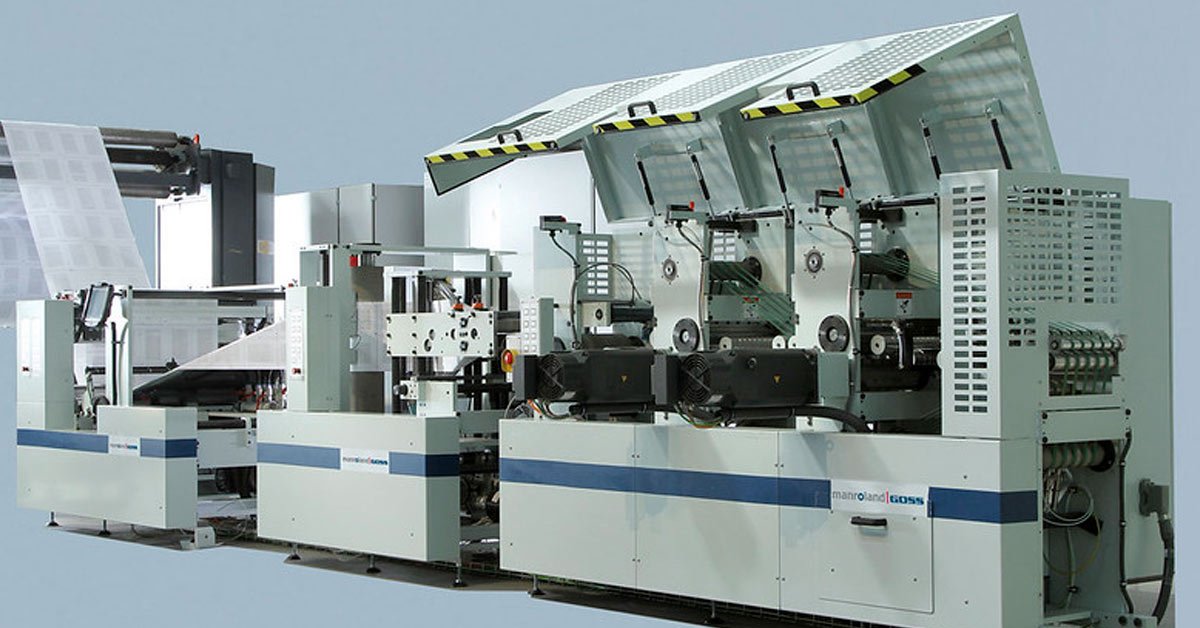
Folding Built for Changing Substrates
FormerLine uses proven web offset folding technology for fold-stable production across paper types. Air-flooded former edges prevent ink set-off, while automatic former control supports consistent fold quality in every run.
- Application range — paper weights extend from 28–150 g/m² with the optional X-range package, supporting a broad range of substrates.
- Flexible configuration — perforation, creasing and cutting knives provide configurable folding options. Suction systems support dust-free production, while softening heads support smooth, high-quality folds.
- Fold control — automatic former control supports consistent fold quality, while the Data-Logic sensor eliminates the need for a print-free gap and enables paper savings.
Cutting and Controlled Shingle Flow
FormerLine’s cutting module is designed for high-precision cutting, gentle processing of lightweight materials, and consistent output.
- Cutting range — the cutting module supports web widths from 105 to 254 mm. Comb cutting provides precise signature guidance, while two-step cutting supports lightweight and bulky materials.
- Web guidance — belt guidance prevents paper jams, an integrated waste gate removes defective signatures, and knife changes can be completed within minutes.
- Production speed — standard production speed reaches 180 m/min, while the speed package reaches 305 m/min. The Displacement Cam module provides uniform shingle flow at 305 m/min.
Together, controlled folding, precise cutting, and stable signature flow protect output quality as different substrates, formats, and production speeds move through the finishing line.
Fast Job Changes Turn Variation Into a Workflow Problem
Once every job differs, output depends less on top speed than on how quickly the line resets between jobs. Pressroom Manager feeds production data back to ERP systems, while Dynamic Production Planning helps optimise production sequence, waste, and changeover time.
Changeover Is the Real Constraint
FormerLine completes a job change in three to five minutes, and the Workflow Bridge stores an unlimited number of repeat jobs for instant recall, so a returning title does not have to be rebuilt. JDF-based presetting drives automated job setup, Imposer supports automated impositioning, and MasterQ supports dynamic production planning within the connected workflow. Both systems run on the PECOM-X automation platform, developed for industrial digital print production with minimal operator effort and easy operation. Together these let the line run many titles in a shift rather than one job quickly.
How Do Fast Changeovers Improve Digital Book Production Efficiency?
In short-run, many-title book production, fast changeovers reduce non-productive time between jobs. Automated presetting and stored repeat jobs enable faster resets, helping printers maintain production flow as titles, formats, and run requirements change throughout a shift.
A line that resets fast keeps variation from stalling output. What it produces still has to hold up in the stage after finishing.
Stable Book Blocks Protect What Happens Downstream
At manroland Goss, we look at finishing as part of the complete production flow. The job is not finished when a signature is folded and cut. The book block must leave FormerLine stable and ready for efficient downstream binding.
- Glue application — FormerLine uses intelligent glue heads with automatic tracking for precise glue application, while auxiliary gluing simplifies product handling during bookbinding.
- Stacking and stability — automated stacking, automatic stack-tray adjustment, post-pressing, and head and foot gluing help FormerLine deliver stable, high-quality book blocks.
- Industrial output — FormerLine can produce up to 7,000 book blocks per hour at 160 pages per copy, depending on printing system and cut-off length.
- Proven in production — At GGP Media, our FormerLine machines operate inline with three HP PageWide T490HD Monochrome presses, producing 400,000+ books per week across up to 190 titles, around 11 million signatures and 135 million printed pages, with ~4% paper waste per run and 28,000+ operating hours over nine years.
For us, these numbers matter because they demonstrate what finishing engineering must ultimately achieve: carrying speed and production variation through to stable book blocks that can move efficiently into the next production stage.
Conclusion
Industrial digital book finishing has become a critical part of modern digital book production. As titles, formats, substrates, and production volumes continue to change, finishing workflows must deliver consistent productivity without compromising quality.
FormerLine combines web handling, folding, cutting, workflow automation, and book-block formation into one integrated digital book finishing architecture. Helping printers maintain efficient production from printed web to binding-ready book blocks while strengthening the overall book finishing workflow.
For Indian book printers evaluating digital book finishing solutions, manroland Goss India combines global engineering expertise with local service and lifecycle support to help build reliable, future-ready production workflows.
Talk to the manroland Goss India team to build a digital book finishing workflow engineered for your production goals.